
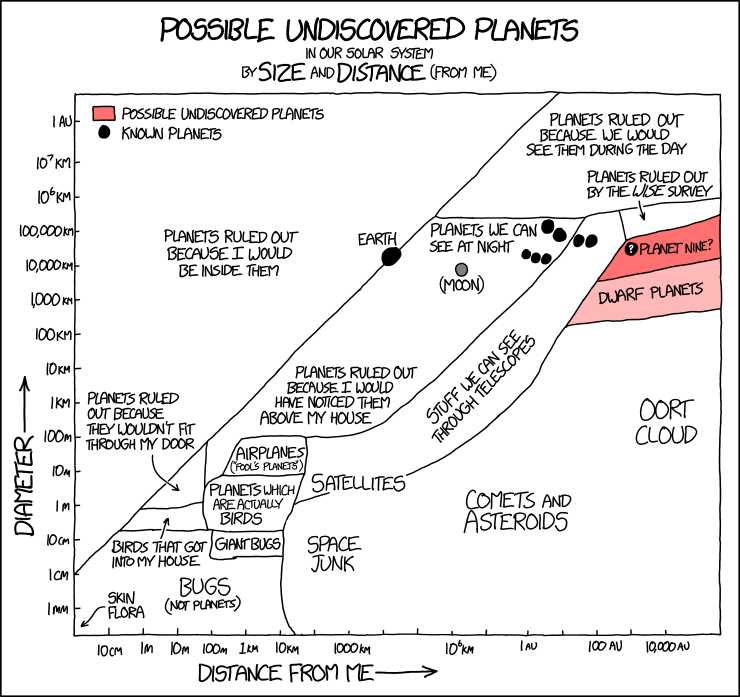
First off… I’d have thought we’d see Pluto included in this plot (and no, don’t tell me “hey idiot, Pluto’s not a planet”–shhhhhhhhuttup~! I know it’s not a planet. But neither are birds, planes, giant insects or literally anything else pictured. The point of the chart is to represent pictorially on a logarithmic scale, all cosmic areas that do, OR DONT, have planets that know about. There is even a section for Dwarf Planets and yet we felt the need to diss poor heartbroken Pluto one more time.
Carrying on.
How crazy is it to think of how vast space actually is. We can point a telescope (a telescope orbiting around our planet no less) to distant objects, nebulae and galaxy clusters billions of light years away. And yet we may still have undiscovered planets in our own solar system?
Granted this potential planet, at it’s hypothetical closest, is still 7 times farther away than even Neptune (our currently defined furthest planet). With an oblong and tilted axis, this sucker reaches distances as far as 1200 AU form our Sun (that’s 111,550,000,000 miles).
But get this… even considering those billions and billions of miles… that’s still less than .02 light years away (just over 7 days). That’s how big space is.
Makes you feel kind of alone and helpless in all that, huh.
 soquitcherbitchen.blog